Why Improvement Fails: It's a Management Discipline, Not a Project
AltoRoc was founded by operators who got tired of watching good organizations stay stuck in the same cycles — and decided to build a firm to fix it.
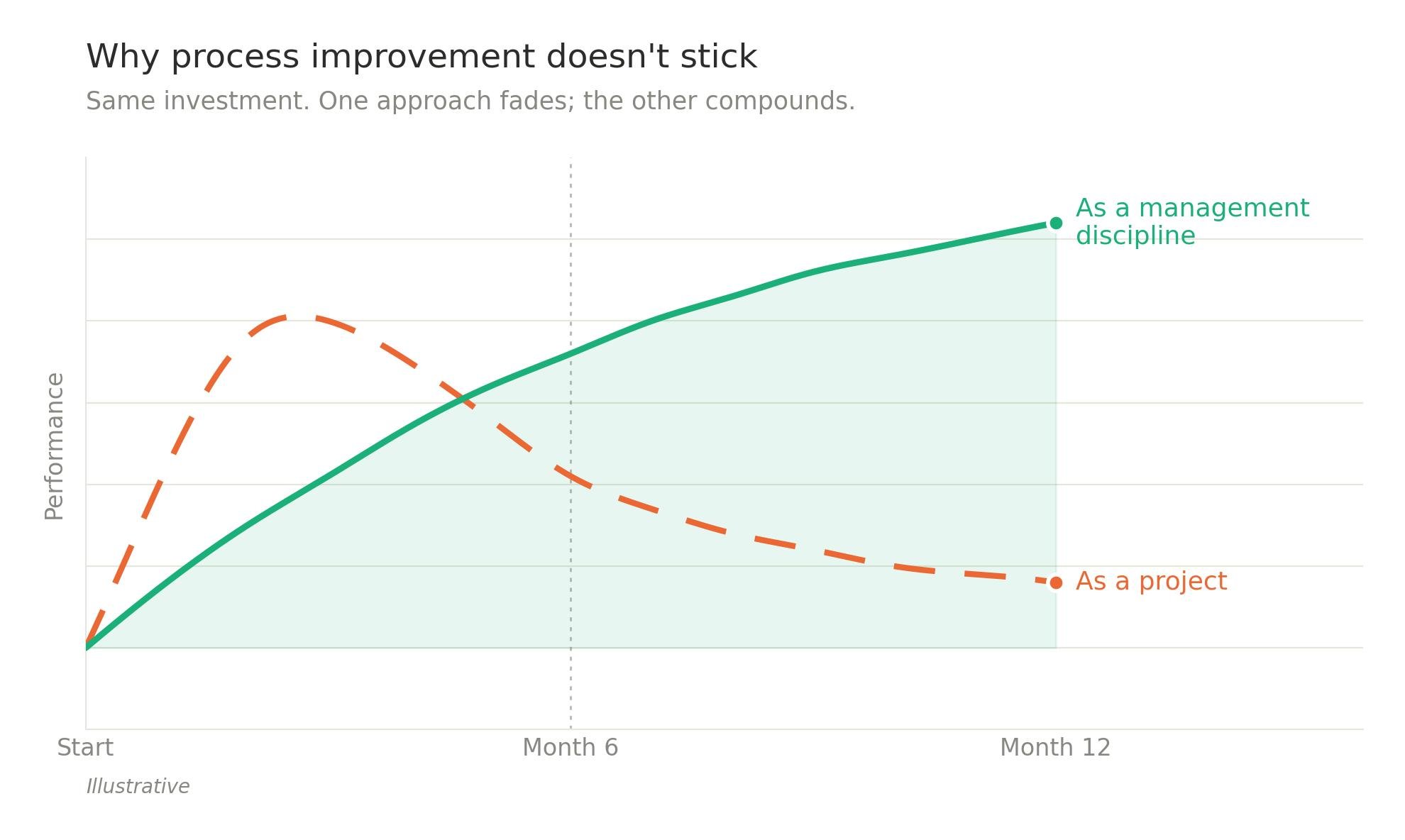
For years, working inside complex organizations across financial services, insurance, and healthcare, we kept seeing the same pattern: capable companies would invest real money in improvement and end up roughly where they started. The projects were run, the training was delivered, the certificates were handed out… And six months later, the same problems had quietly returned. The work wasn't wrong; it just never took hold.
AltoRoc Partners exists to close that gap: the distance between knowing what needs to improve and actually making improvement stick. That's the problem we were built to solve, and it's why we work the way we do.
The Gap Between Knowing and Doing: What we believe
Our belief is simple: when people have clear processes, the right tools, and leadership that coaches rather than controls, performance follows and improvements stick.
We hold an equally strong belief about why improvement so often fails, and it's less comfortable. Most organizations treat improvement as a project; a thing you run, finish, and check off. But lasting improvement comes from clear ownership, better conversations, and disciplined follow-through, not another framework on a slide. When past efforts didn't stick, it usually wasn't because the methodology was wrong, it's that improvement was treated as a project instead of a management discipline. The operating rhythm was the missing piece.
That belief also shapes how we define good consulting: the best consulting doesn't create dependency, it builds strength. We don't theorize about what should work. We stay embedded with your team, own the results alongside you, and leave the organization more capable than we found it. Our model is partnership, not substitution — and our work isn't headcount reduction, it's making sure the right people are in the right roles doing the right work.
At the Core, We’re Operators, Not Advisors
Our team has spent decades inside complex organizations, leading operational excellence programs, coaching leaders through transformation, and owning the outcomes. That lived experience is the difference. We don't grade performance from the outside; we come in as peers who've sat in the same seats and know the difference between a change that looks good in a report and one that holds up on a Monday morning when everything is behind.
It's why we lead with judgment rather than dogma. We draw on proven methods — Lean Six Sigma, ADKAR change management, performance management — and organize them through a simple arc we call ALTO:
▹ Align on the problem and the outcomes that matter,
▹ Learn the root causes,
▹ Transform with real solutions, and
▹ Own the results so they hold after we've stepped away.
But we adapt the approach to fit the situation, not the other way around. The real skill isn't applying a framework by the book; it's knowing when to simplify, when to go deep, and when to lead with judgment. One principle runs through all of it: we build quick wins into the early stages, so credibility builds while the deeper work takes root.
What we do
Our work spans a few connected altitudes, from the frontline workflow to the enterprise operating model.
At the process level, we map current-state operations, find where friction and waste live, and redesign how work flows. We then build the daily management routines (huddles, visual boards, performance reviews) that keep improvement alive, so the same problems stop showing up on Monday morning. Through our dedicated training practice, Lean Six Guy™, we build real, lasting capability at every level.
At the enterprise level (business transformation and organizational design) we work on the structural and behavioral architecture that determines whether change holds: how strategy becomes execution, how decisions get made, who owns what, and how performance is governed. We don't layer change on top of dysfunction; we rebuild the foundation. And we design the organization around its strategy, not its legacy — because most organizations aren't designed, they're inherited.
Underneath all of it is change leadership, because change doesn't fail because of the plan, it fails because of the follow-through. We coach leaders to manage with data, lead through ambiguity, and hold the standard — not just during the project, but as a permanent operating discipline. The result is change that becomes culture, not another initiative that fades.
The through-line is that we scale the method, not dilute it. In a large enterprise, that means alignment across many teams. In a smaller organization, it means just enough structure to drive performance without bureaucracy. Same discipline, different shape.
Organizations We Work With
We go where operations are complex, the stakes are high, and getting it right the first time matters. We have deep experience across insurance, banking, healthcare, and retirement services. Our clients are the leaders who own the problem: the COO, the head of operations, the VP or director accountable for results who feels the weight of that responsibility every day. They're smart, capable, and stretched thin, and they've seen enough flavor-of-the-month initiatives to be skeptical of another one. They don't want hype; they want clarity, honesty, and a partner who understands what it's actually like to run a complex organization.
What they're really after isn't a project; it's confidence — that the work their teams do matters, that problems are being solved at the root, and that the organization can keep improving in a way that's both sustainable and that the organization can keep improving without burning its people out. Because in the end, the biggest risk isn't failure… It's staying the same.
Where to Start with AltoRoc
Most leaders come to us knowing something needs to change but not entirely sure where the real problem is, or which one to tackle first. That's exactly why we offer the Amnesty Session: a facilitated, blame-free working session where your leadership team surfaces what's actually getting in the way, without politics, finger-pointing, or fear.
No proposals. No pitch decks. Just an honest conversation that leads to action. The ground rule says everything about how we think: blame the process, support the individual. Because that's where real improvement starts — not by finding someone at fault, but by finding and fixing what's actually broken.
That's what we built AltoRoc to do: not run another initiative that looks good in a presentation, but change how the organization operates — and make it stay changed. That's what turning strategy into impact really means.